Tying shoelaces...

AI in training: from PDF to active learning – step by step

From content to active learning with AI

“The problem isn’t a lack of content—it’s a lack of time/capacity to turn it into learning that people actually use.”


Many organizations already have everything they need in PDFs, presentations, procedure descriptions, and internal documents. The challenge is rarely a lack of information, but a lack of time and capacity to turn that information into learning that’s actually used day to day. Training often ends up as passive courses that are easy to “click through,” but hard to translate into action.


Active learning is the opposite: participants do something, they make choices, solve tasks, reflect, and collaborate. This is where game-based learning and interactive missions can drive participation, engagement, and better transfer to practice. The point isn’t to turn everything into “games,” but to make learning more active and relevant through small tasks that train what people actually need to master.


With an AI agent, you can quickly go from content to tasks and active learning experiences. In Wittario Studio, you can use Witty: add existing material and use it as a starting point, so you spend more time on quality, level, and adaptation - and less time producing everything from scratch.

Step by step: from PDF to active learning with AI
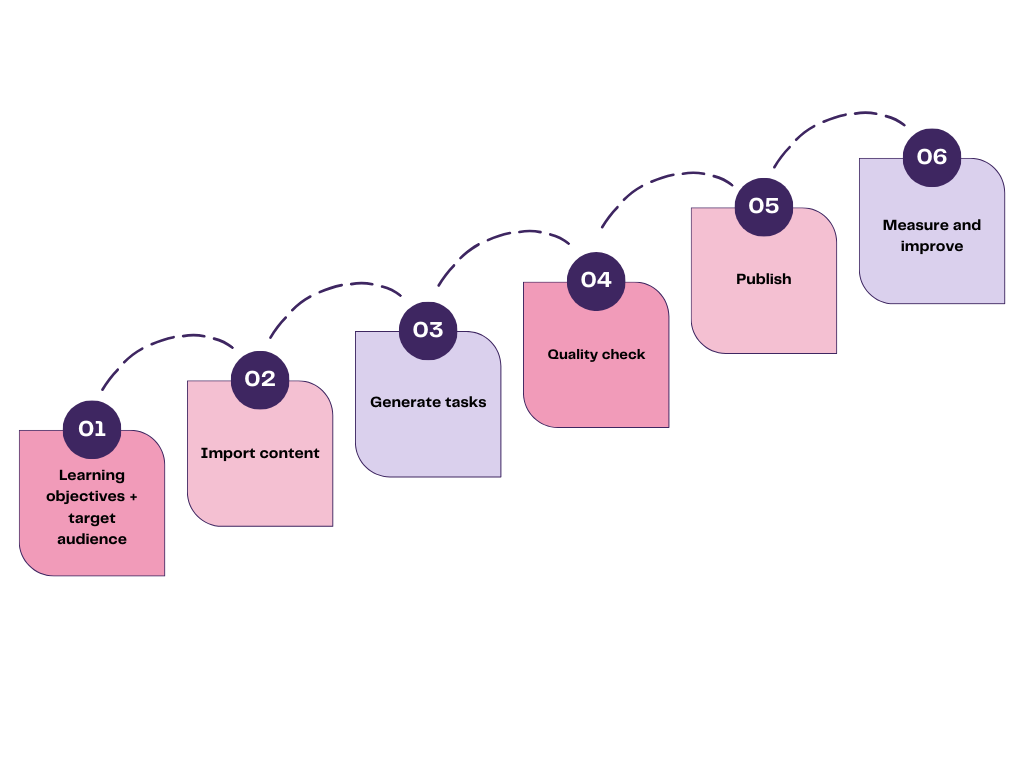
“A simpler path from content to learning”: AI is used to turn existing material into tasks and active learning experiences.

Many teams have the content ready, but turning it into active learning takes time. With Witty, you can use existing material as a starting point and quickly get to a first draft, so the learning team can focus on quality, level, and adaptation, not manual production from a blank page.

  1. Choose one learning objective and a target audience

Start with a concrete goal: What should participants be able to do afterward? Clarify who the learners are: new hires, leaders, students, or a specific role. A clear goal makes it easier to choose the right task type (quiz, reflection, case) and the right difficulty level.

  1. Import/paste content (PDF/procedures, etc.)

Upload or use existing material such as a PDF, presentation, or procedure document. The point is to reuse what you already have and avoid starting from zero.

  1. Get task suggestions (quiz, reflection, case)

Ask Witty to generate a first draft of active tasks based on the content you’ve added, for example:

–Quizzes to check understanding

–Reflection questions to support transfer to daily work

–Case/decision tasks where learners must make choices

  1. Quality-check language, level, and relevance

This is the most important step. Use the time you save by not starting from scratch to:

–Simplify language and make questions clearer

–Ensure the right level for the audience

–Remove “fluff” and keep it work-relevant

–Add examples from your own organization

This is where quality is created: Witty provides a draft, and you make it precise and relevant.

  1. Publish as an active learning experience

Once quality-checked, tasks can be assembled into a mission that fits the context: a short learning sequence, a game/mission, or an activity that can be completed anytime. The goal is low friction and high participation.

  1. Measure and improve

See what works: where people drop off, which questions are misunderstood, and what creates the best reflection. Improve in small iterations. That’s how you build consistency and continuous development, without large project cycles.

From “content storage” to a learning engine

Many teams already have the content ready. The challenge is turning it into active learning that’s used in practice. With the AI agent Witty, you can quickly go from documents to tasks and spend less time on manual production. The result is more relevant internal training, faster onboarding, and learning that’s easier to update and reuse over time.

The result when the barrier is lowered: more learning that actually happens

When it becomes easier to create learning, more learning happens: faster onboarding and competence development, more engaging experiences, and better use of your existing content.

When you can use existing material as a starting point and quickly turn it into active tasks, it simply becomes easier to produce learning. And when the threshold for creating learning goes down, more learning happens: faster onboarding and competence development, more engaging learning experiences, and better use of the content you already have.

Engagement: Game-based mechanics and activity make training more entertaining and challenging, increasing motivation and the likelihood that knowledge is understood and applied.

Variety and adaptation: When content can be turned into different task types, it’s easier to meet different learning styles and levels and keep participants active.

Reuse and updates: When learning experiences are easy to produce, update, and reuse, both time and costs go down and training becomes more sustainable over time.

Where this creates the most value

AI for onboarding:

Onboarding rarely suffers from a lack of content - you already have PDFs, documents, and procedures. The challenge is making it easy to take in, easy to remember, and easy to use. When content can quickly become short missions and active learning, new hires get an overview while also checking their understanding along the way.

The biggest gains are often faster belonging and faster time-to-productivity. Game-based, team-oriented tasks make it easier to get to know people and culture while learning routines and expectations in practice. You can also track progress and see what works, and what should be improved in the onboarding flow.

AI for internal training and procedures:

Internal training often dies in documents - processes, guidelines, HSE requirements, and “how we do things here” remain heavy text or become click-through courses without behavior change. With an AI agent, you can use existing material as a starting point and quickly turn it into active tasks employees must take a position on, so they actually practice what you want them to master.

Culture in practice is built through habits, values, and small choices that shape daily collaboration and affect both well-being and performance. When values become repeatable micro-missions and concrete situations, culture becomes easier to live, not just talk about.

Gamification of content:

Gamification is using game elements in non-game contexts to increase motivation, participation, and learning outcomes. This can be points, progression, small goals, rewards, collaboration, and friendly competition, the point is to make learning more active, social, and concrete.

This is especially useful when content feels dry or heavy: when people must do something themselves (solve, choose, create, collaborate), they move from passive observers to active participants.

Frequently asked questions

What is an AI agent?

An AI agent helps you turn existing content into learning experiences that involve participants. The goal is a simpler path from content to learning and fewer passive courses.

Can AI turn a PDF or PowerPoint into e-learning/active learning?

Yes, the point is to reuse what you already have. Witty is designed to use existing material as a starting point. You can upload PDFs, PowerPoint, Word, and Excel documents and turn the content into active learning experiences.

How do we quality-check AI-generated learning content?

Use AI for the first draft and have subject-matter experts review before publishing. Check: facts and terminology; level and language for the audience; relevance to work tasks; and whether tasks train the intended behavior (not just recall).

When should we use active/game-based learning instead of passive courses?

When the goal is for people to do something in practice - make decisions, solve tasks, collaborate, or reflect, not just consume information.

What’s the practical benefit of using AI in training?

When the barrier to creating learning is lower, more learning happens: faster onboarding and competence development, more engaging learning experiences, and better use of existing content, with less manual work.

Good use of AI in learning: 4 principles that work

- Start with one goal: What should participants be able to do afterward?

- Keep it short: Split into micro-missions/modules that are easy to complete

- Vary formats: Combine quizzes, reflection, and cases, not just multiple choice

- Measure and adjust: Use AI as a first draft and improve in small iterations based on what works

Test Witty for free in Wittario Studio

Start with one learning objective, let Witty suggest tasks, and fine-tune language and level before sharing with participants. Easy to update and reuse over time.

Get started now